
The Anatomy of the RMX-IGNITE: What AlphaTheta's First RMX Refresh in 13 Years Says About DJ Performance Today
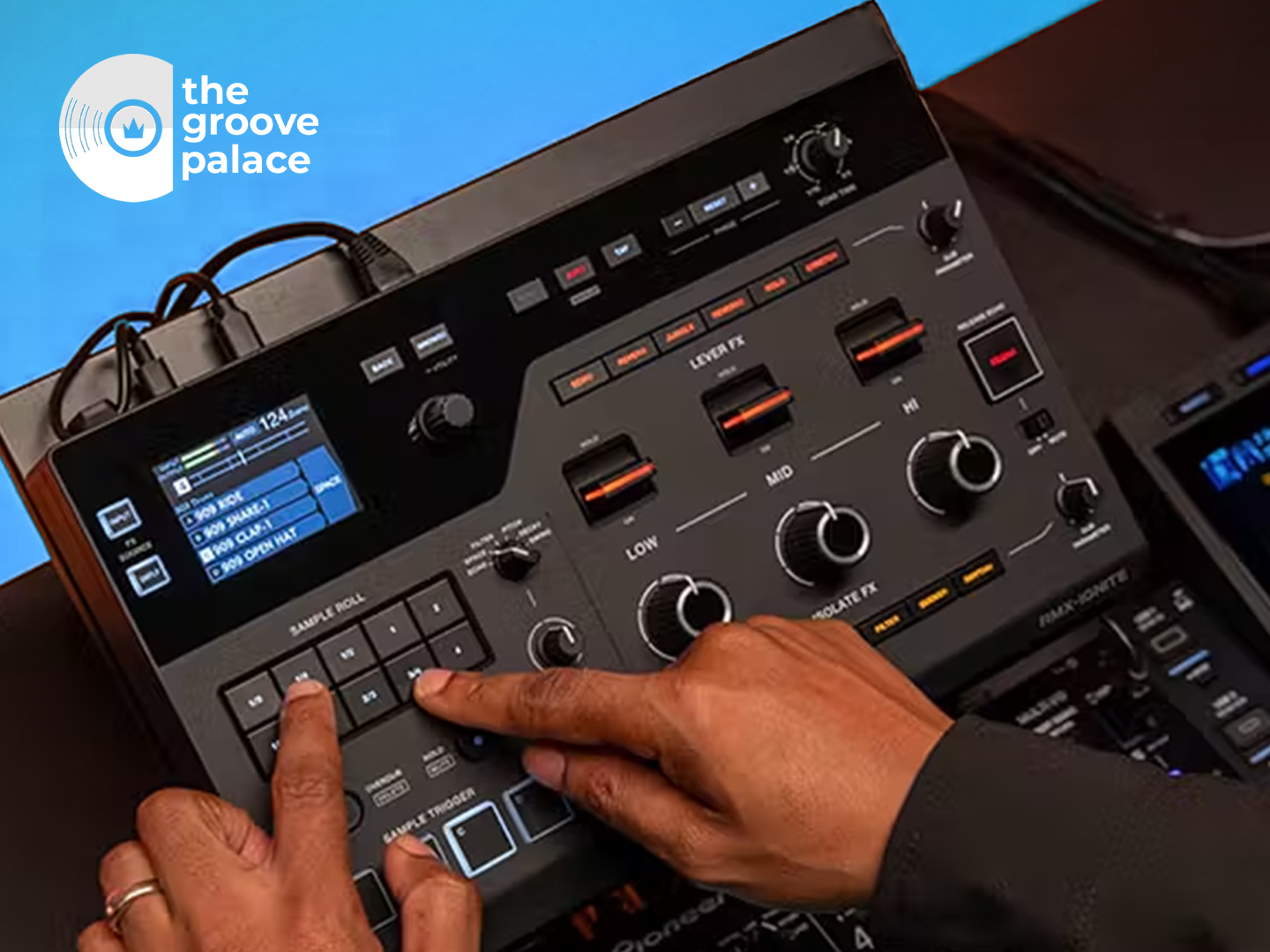
After 13 years, AlphaTheta has introduced the RMX-IGNITE—the first new model in the RMX line since the RMX-1000 launched in 2012. On paper, it's a next-generation performance effector with upgraded sound processing, expanded effects control, and a redesigned sampler. In practice, its arrival invites a broader question: why revisit dedicated performance hardware now, in an era dominated by software and all-in-one systems?
Rather than positioning the RMX-IGNITE as a radical reinvention, AlphaTheta frames it as a refinement—one designed to support expressive, hands-on DJ performance. The timing, the design choices, and the restraint of the update all suggest a deliberate response to how DJing has evolved over the last decade.
What the RMX Is—and What It Isn't
At its core, the RMX-IGNITE is a hardware performance effector. It sits alongside a DJ mixer and processes audio in real time. Where a mixer focuses on track selection and blending, the RMX focuses on manipulation: altering frequencies, reshaping transitions, and applying time-based effects during playback.
The RMX-IGNITE does not replace a mixer, DJ players, or performance software. Instead, it occupies a specific role within a DJ setup: enabling real-time sound shaping through tactile controls. AlphaTheta's language is careful here, describing the unit as a way to "show individuality" and "spark creativity," rather than promising any particular outcome.
That distinction matters.
A Refined Approach to Performance Control
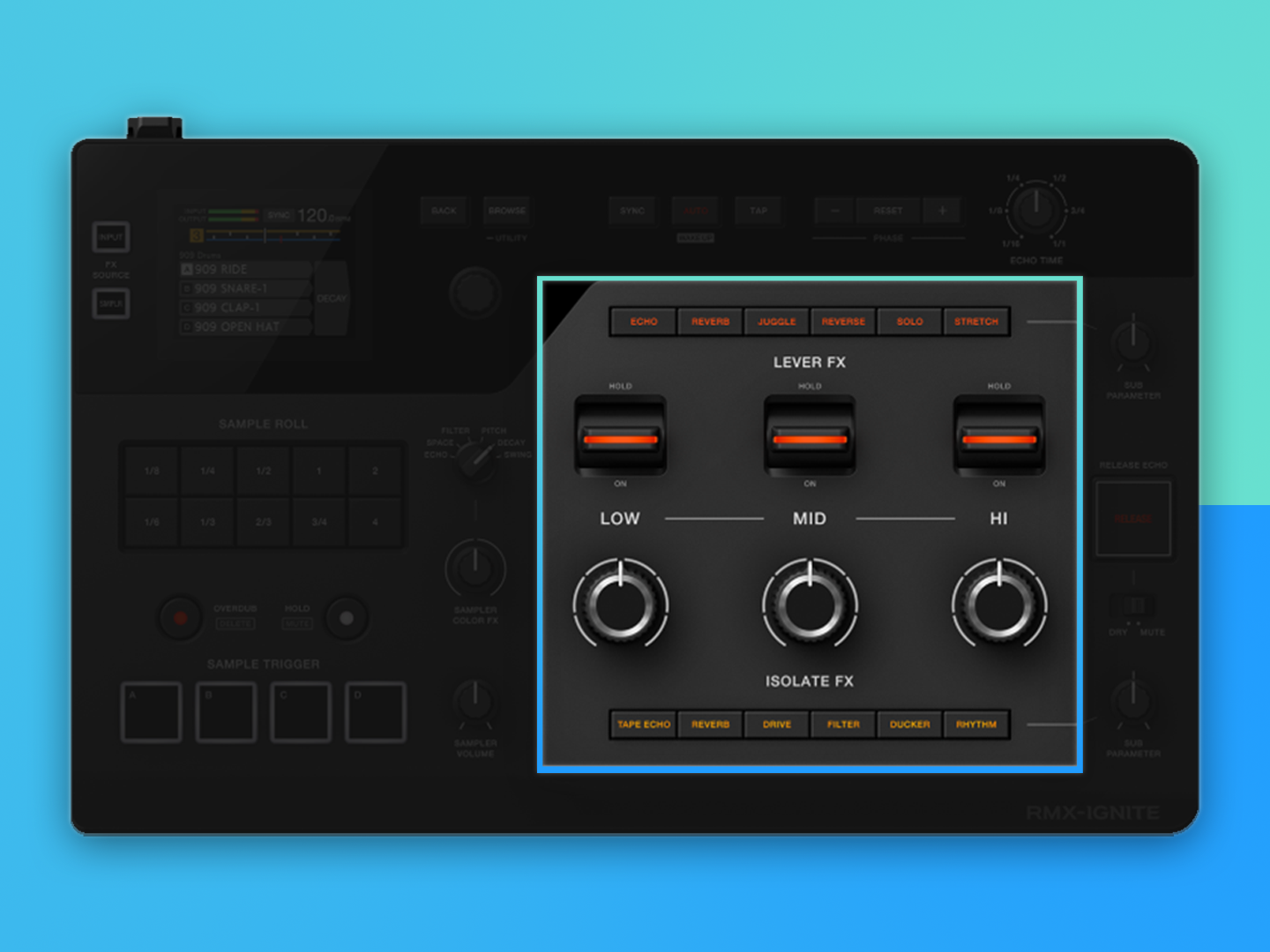
One of the most significant updates in the RMX-IGNITE is its 3-Band FX architecture, which divides effects control across high, mid, and low frequency ranges. Each band can be processed independently using two effect types:
Lever FX, designed for immediate, dramatic changes
Isolate FX, designed for smoother, continuous transformations
Each category includes six effects, and each band has its own sub-parameter control for tonal adjustment. This structure allows DJs to affect specific elements of a track—such as vocals or percussion—without applying effects across the entire mix.
Importantly, AlphaTheta avoids framing this as complexity for its own sake. The emphasis is on clarity and immediacy: large knobs, clearly separated frequency bands, and a layout intended to reduce hesitation during performance.
The Sampler: Expanded, but Purpose-Built
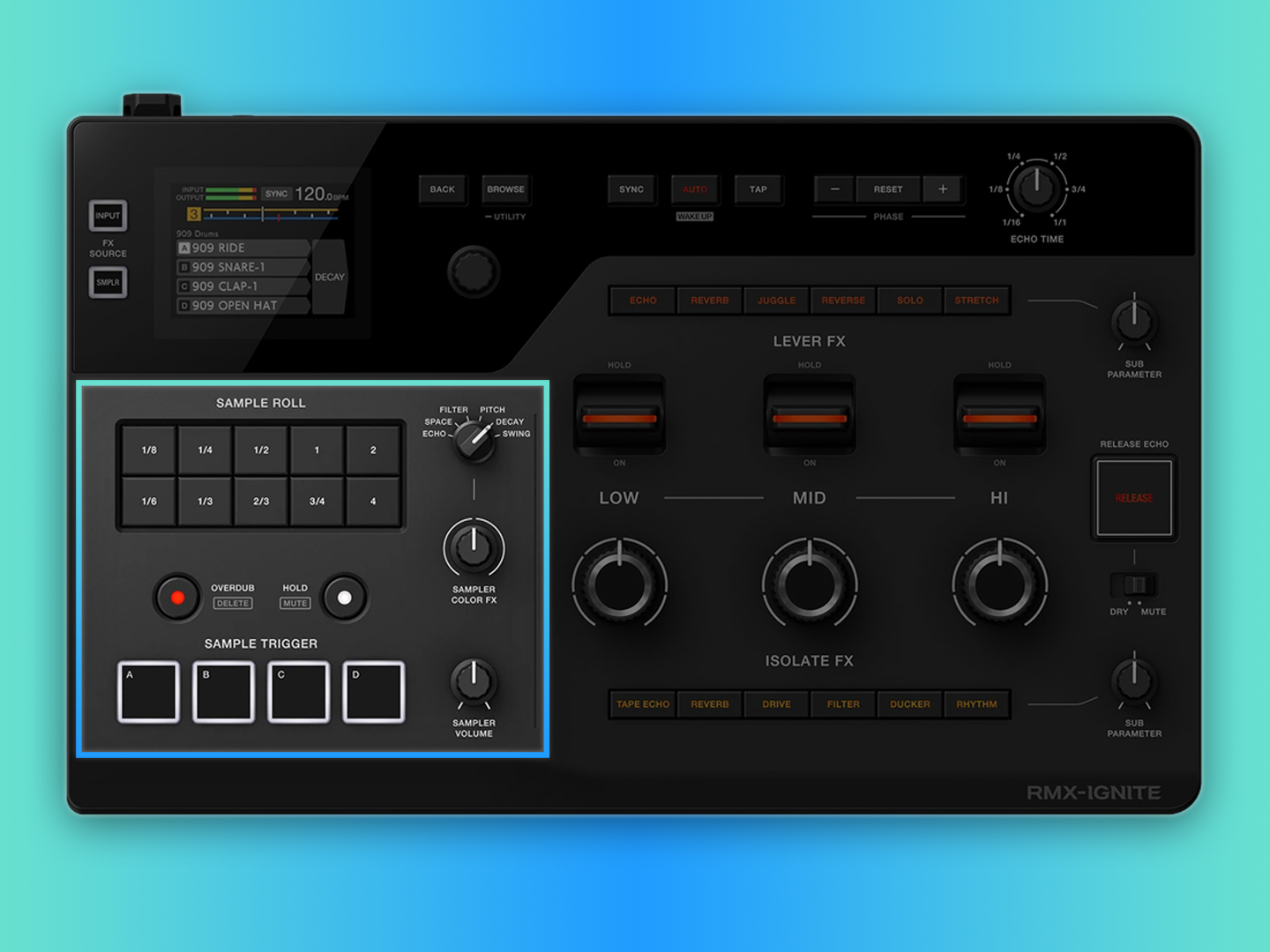
The RMX-IGNITE includes a redesigned sampler section with four rubberized pads and integrated roll functions. It ships with 20 built-in samples from Loopcloud, and supports user-loaded samples via USB using the RMX-IGNITE Sample Manager software.
Key capabilities are clearly defined:
Samples can be triggered as one-shots or loops
Overdub mode allows looping and layering in 1-bar phrases
Sample Roll supports multiple rhythmic divisions
Groove Roll enables accented roll combinations by pressing multiple roll buttons
Sampler effects—Echo, Space, Filter, Pitch, Decay, and Swing—are controlled independently from the main 3-Band FX section using a single knob
The design intent here is not to turn the RMX-IGNITE into a full production tool. Sample length is capped, and workflows are optimized for short, expressive gestures, not extended arrangement. The sampler is positioned as a performance layer, not a replacement for DAWs or live production setups.
Release Echo and the Importance of Exit Strategy
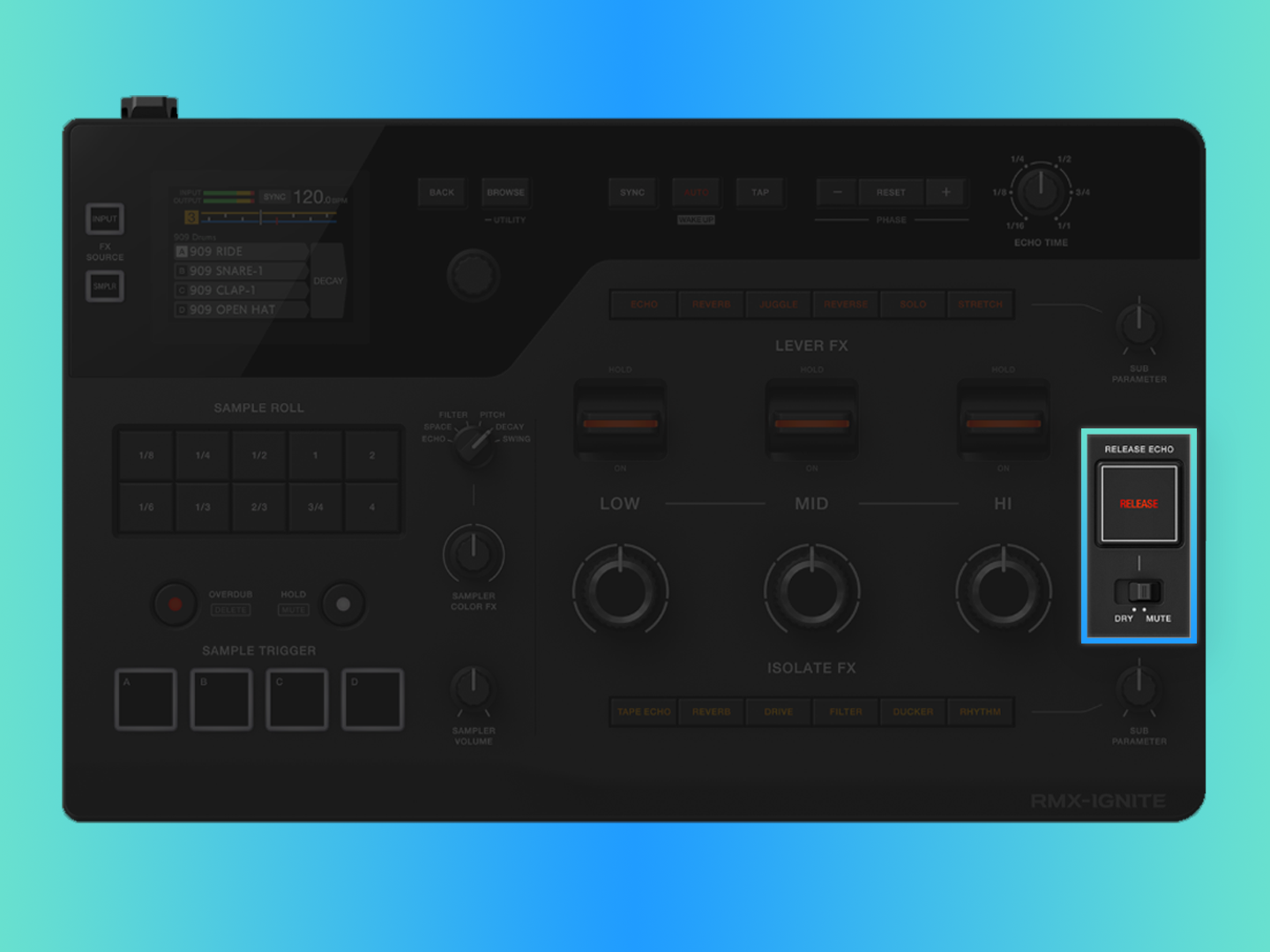
One of the more understated but meaningful additions is Release Echo. With a single button press, all active effects and samples are cleared while applying an echo tail to the audio.
Two modes are available:
Dry, where the track continues underneath the echo
Mute, where the audio briefly cuts before returning
This feature addresses a practical performance concern: exiting complex effect combinations cleanly. AlphaTheta presents it as a way to maintain musical flow, not as a dramatic tool in itself.
Integration and Signal Integrity
The RMX-IGNITE supports multiple connection methods depending on setup:
Analog send/return via TS jacks
Digital send/return via USB with compatible mixers
BPM and grid synchronization via PRO DJ LINK
For supported mixers, digital routing allows audio to remain entirely in the digital domain. BPM information can be received via PRO DJ LINK, detected from audio, or manually set if needed.
Internally, the unit features 96 kHz / 64-bit DSP processing and 32-bit ESS A/D and D/A converters. AlphaTheta states that the audio architecture was redesigned and fine-tuned through real-world listening tests, with the goal of maintaining clarity when stacking effects.
These specifications are presented without exaggeration: improved transparency, not transformation.
Hardware in a Software-First Era
From a technical standpoint, many of the RMX-IGNITE's capabilities can be replicated in software environments. The RMX-IGNITE exists for DJs who value physical interaction, visual feedback, and muscle memory as part of performance—qualities software can't fully replicate.
This is where interpretation enters—not as speculation, but as context.
The RMX-IGNITE reflects a view of DJing as an expressive practice, not purely a playback task. Its levers, knobs, and pads emphasize motion as much as sound. AlphaTheta's repeated references to "sound and movement" suggest that the physical act of performance remains culturally relevant, even as software becomes more powerful.
Why This Update Exists Now
The RMX-1000 remained in circulation for over a decade—not because AlphaTheta forgot about it, but because it didn't need replacing. The RMX-IGNITE arrives now because something has shifted: DJ setups are increasingly hybrid, combining players, mixers, software, controllers, and external hardware.
The question isn't whether DJs still want performance tools—it's whether they want dedicated performance tools, or if software and all-in-one controllers have absorbed that role.
Rather than attempting to consolidate functions, the RMX-IGNITE does the opposite: it specializes. It focuses narrowly on live manipulation, integrates cleanly with existing systems, and avoids overextension.
This restraint may be the most telling aspect of the release.
Who the RMX-IGNITE Is For
The RMX-IGNITE is not positioned as essential equipment, nor as a universal upgrade. It is designed for DJs who already think about performance as something shaped in real time—those who value immediacy, tactile control, and intentional interaction with sound.
AlphaTheta does not frame it as a solution for everyone. And that clarity strengthens its relevance.
Final Thought
Thirteen years is a long time in music technology. AlphaTheta's decision to wait before revisiting the RMX line suggests patience rather than neglect. The RMX-IGNITE does not attempt to redefine DJing, nor does it compete with software on features alone.
Instead, it refines a philosophy: that performance tools should feel like instruments, not interfaces.
In an era where most gear tries to do everything, the RMX-IGNITE does one thing—and bets that for some DJs, that's enough.